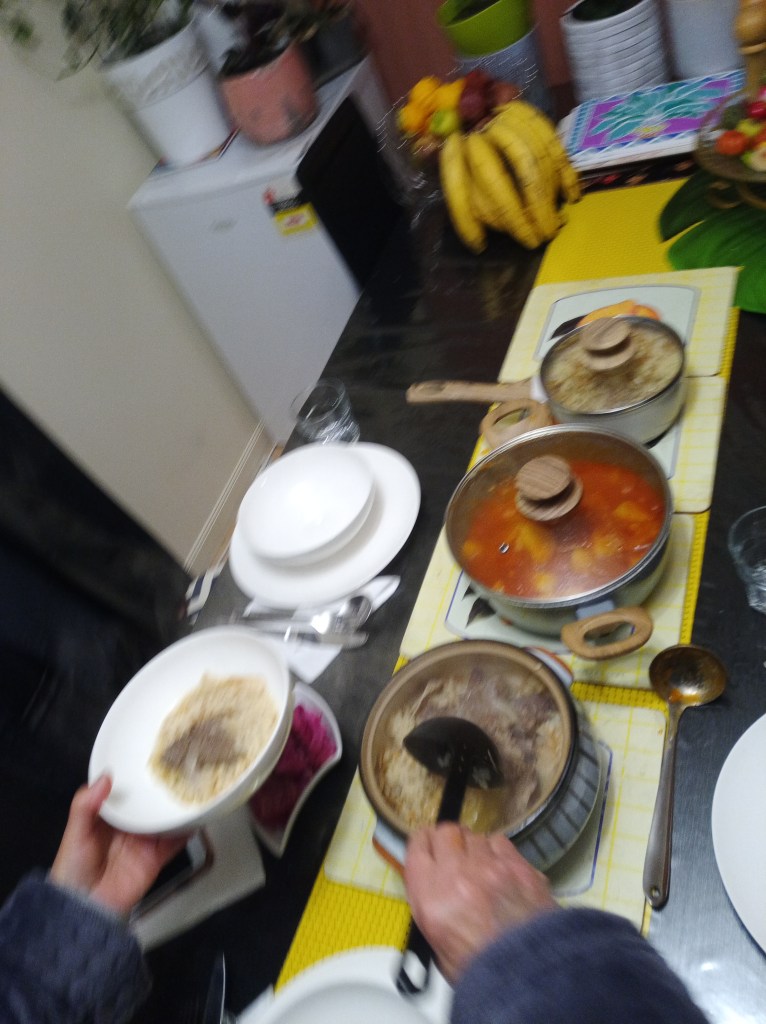
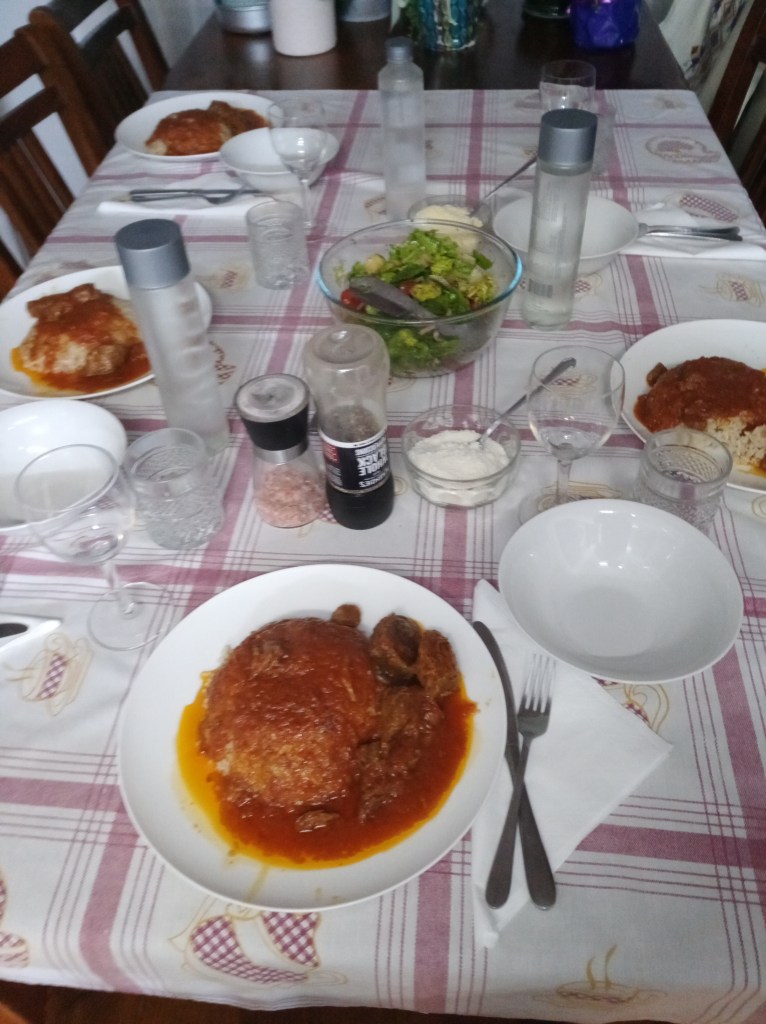
I’ve been considering food as a mode of transmission and a way of individuals contributing to other’s ecologies through cooking.
THE BED (subsection 2.5)
ok so i found this huge matrix for how much potassium is in a whole bunch of foods and im gonna make a recipe and figure out the equivalent radiation .
This resource is american and very specific.
Banana doesn’t make it onto the grid (weird move USDA) but the following banana related ? foods do:



There’s 24 pages of this.
so now i have to choose another constant. or really make a constant for my constant.
so:
i collated the relevant conversions:
| 100g banana = | 358 mg Potassium (K) |
| 1000 mg = | 1 gram |
| 1 oz. = | 28g |
| 1 cup = | 240g |
for my constant I’m going to choose something with the same g: K ratio as banana.
so, per 1g : 3.58 mg K
(I’m literally working this out as I go I haven’t edited this so this may all be unnecessary)
ok my brain hurts i think im going the wrong way
ok wait
no i know what i did wrong.
I’ve introduced a new data set without amalgamating it to what i was originally looking at so im freaking out.
this is my original table from the BED pt. ii
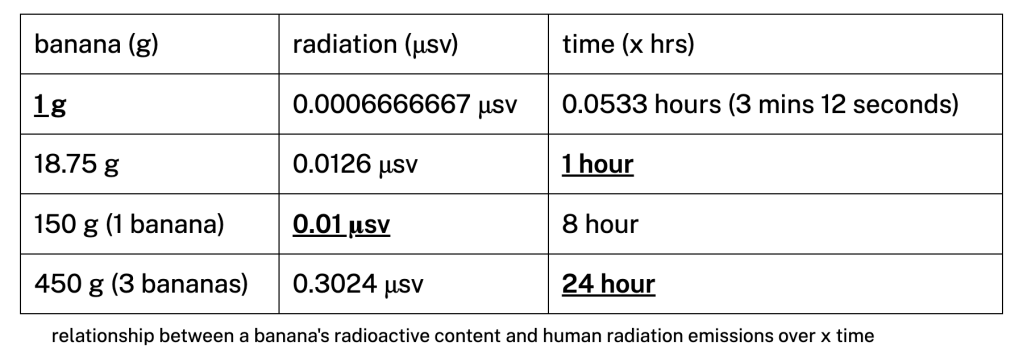
and amended for potassium:
| banana (g) | potassium (mg) | radiation (msv) | time (hrs) |
| 1 g | 3.58 mg | 0.0006666667 | 0.0533 (3 mins, 12 seconds) |
Now I can just enter the potassium and work backwards from there . maybe?
lets fkn try
I’m going to start with pancakes because I’ve been listening to the braiding sweetgrass audiobook and there is so much maple syrup/pancake content.

depressing… but i think this is specifically for household and prepackaged goods
at 77g per pancake, with 4 pancakes per serve, thats 308 g
308/28 = 11
90 x 11 = 990 mg K

ok a regular serves 16 recipe asks for 1 3/4 cups
divide by 4 is about half a cup (these are thin pancakes)
so 538 x 2 = 1076

again. depressing that its not maple but whatever. 1 cup is way too much. lets do 1/4 of a cup?
69/4 = 17.3

theres no fruit so i guess we’ll have ice cream. leave it at 133.
T: 990 + 1076 +17.3 + 133 = 2216.3
alright so, given the table, lets create a ratio for the potassium
| banana (g) | potassium (mg) | radiation (msv) | time (hrs) |
| 1 g | 3.58 mg | 0.0006666667 | 0.0533 (3 mins, 12 seconds) |
2216.3/3.58 = 619.1
now multiply everything by 619.1:
| banana (g) | potassium (mg) | radiation (msv) | time (hrs) |
| 619.1 g | 2216.3 mg | 0.41273 | 32.99 |
i dont know enough about anything for this to feel right??????
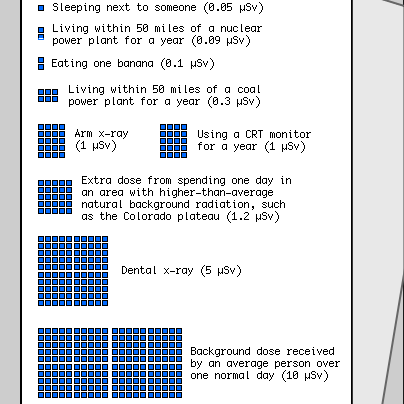
that would mean eating pancakes (according to the model) would be equivalent to living within 50 miles of a coal power plant for a year (see above).
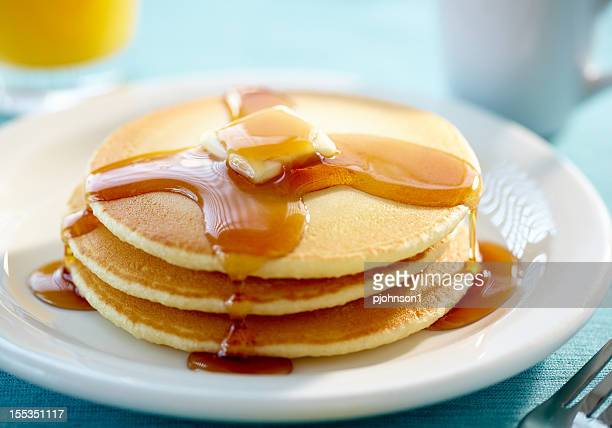
1 pancake breakfast : 33 hrs of human contact
This isn’t real, I know that. I dont have the numerical/scientific literacy to prove it, but I know either I fucked up the math, there is a factor I haven’t accounted for or this is literally just not how it works. But if the banana is a model it follows that anything could be a model if you keep the BED / potassium content as the baseline.
also. The guy who made the chart, Randall Munroe adds the below disclaimer at the bottom of the image:

“i’m sure ive added in lots of mistakes; it’s for general education only. If you’re basing radiation safety procedures on an internet PNG image and things go wrong, you have no one to blame but yourself”
lmao go off.
He’s got a physics degree and Ellen is literally a radiation researcher. This shit is so hard to articulate accurately in the languages we are capable of.
In the context of the human body, eating pancakes is not the same as living next to a power plant. Homeostasis prevents the accumulation of potassium and most other elements. This is one of the major criticisms of the BED as a model, that it disregards the reality of the human system.
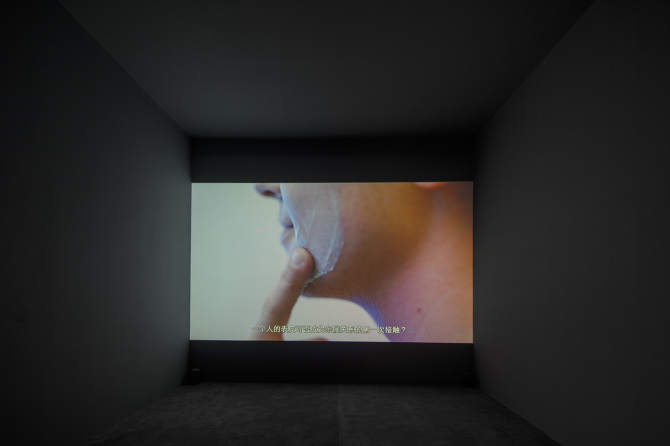
Marguerite Humeau’s FOXP2 and Jes Fan’s Mother is a Woman come to mind.

Humeau dissolves the idea of humanness into a solution, soaking a carpet for speculative post-human elephants to rest on. The elephants themselves have been constructed by robots and printers, with as little ‘human hand’ as possible (although I kinda don’t see how that tracks since humans built the robots/software/mined the minerals/built the warehouses ect). Still, I love this work.
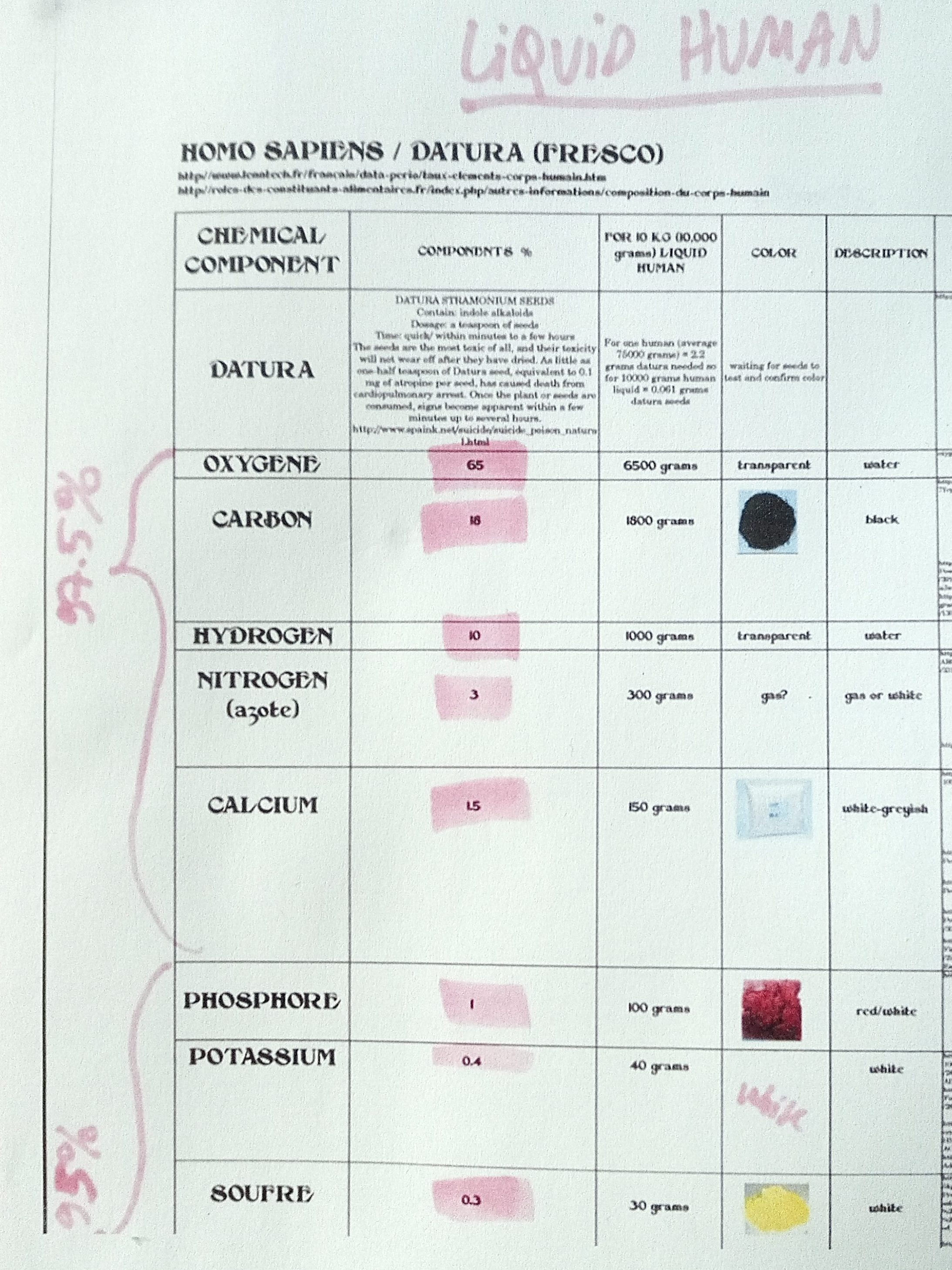
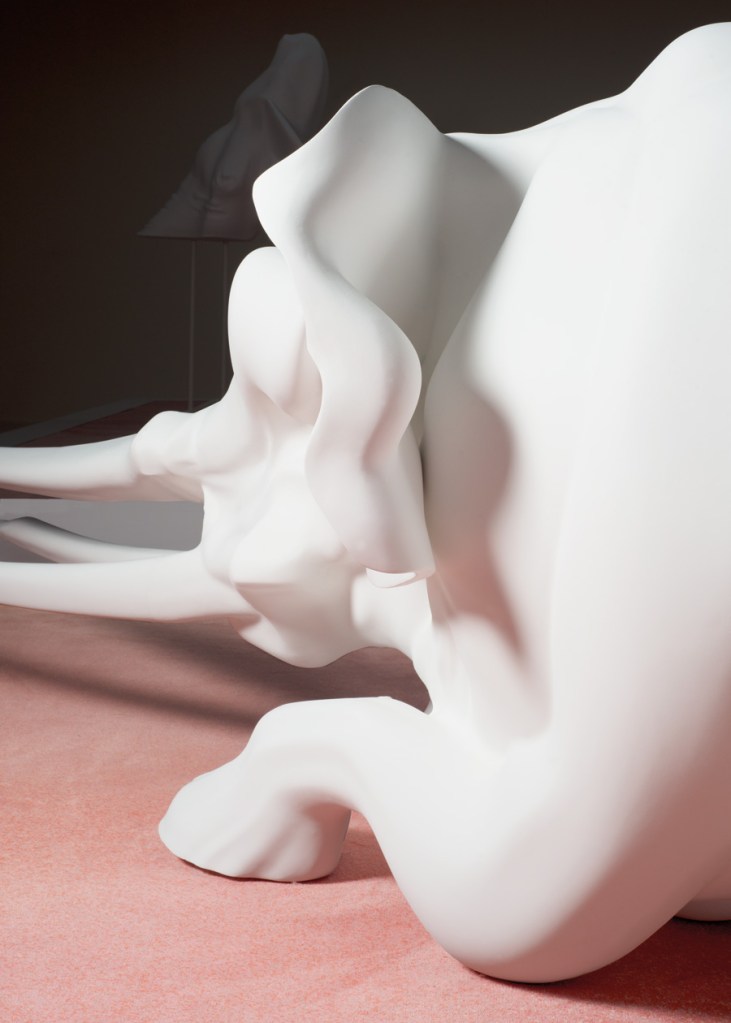
What is it though, is it essentialising an identity? a danger? a specialty? until it becomes removed from the broader system it inhabits. It becomes innocuous. An inoculate. Re-animated in the viewer’s mind.
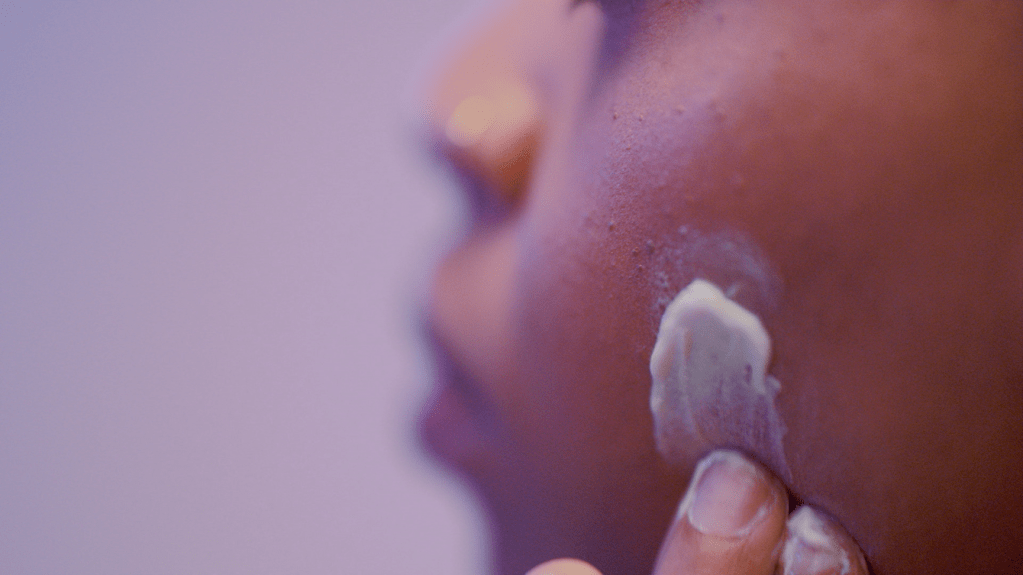
Fan synthesises a lotion made from his mother’s estrogen, extracted in a lab from her urine. Does it become something else now? Do you become something else if you use it?
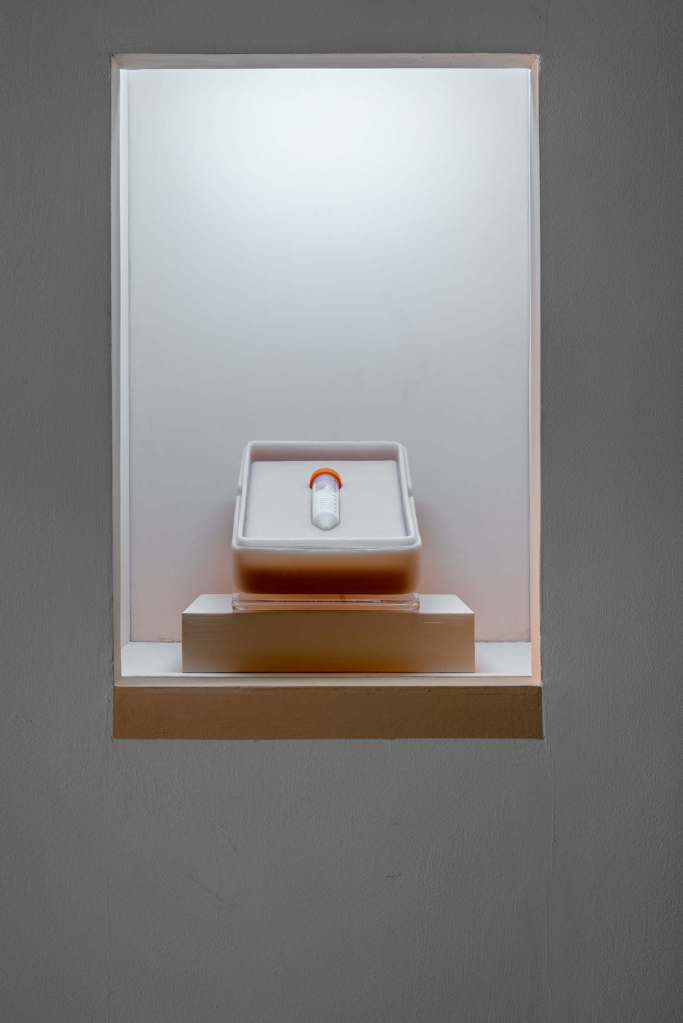
4:44, HD, stills.
Video, Color, Sound
Videographer: Asa Westcott
How much do the elements of a recipe contribute to the final result? I’m starting to find the harder I look, the distinction dissipates.
Maybe only the recipe/process/relationship matters.
I’m getting back into cooking and know instinctually how things interact and affect each other in a dish. I think I have the same approach to my practice?
idk!
 CROSS SECTION
Leave a comment